Quick Summary
- International conventions mean shapes and colours carry consistent meaning across many countries — triangles warn, circles instruct, octagons mean stop.
- Red typically signals prohibition or danger; blue often gives positive instructions; these colour cues are remarkably consistent worldwide.
- A translation app with camera functionality helps with text-heavy signs that symbols alone can't convey.
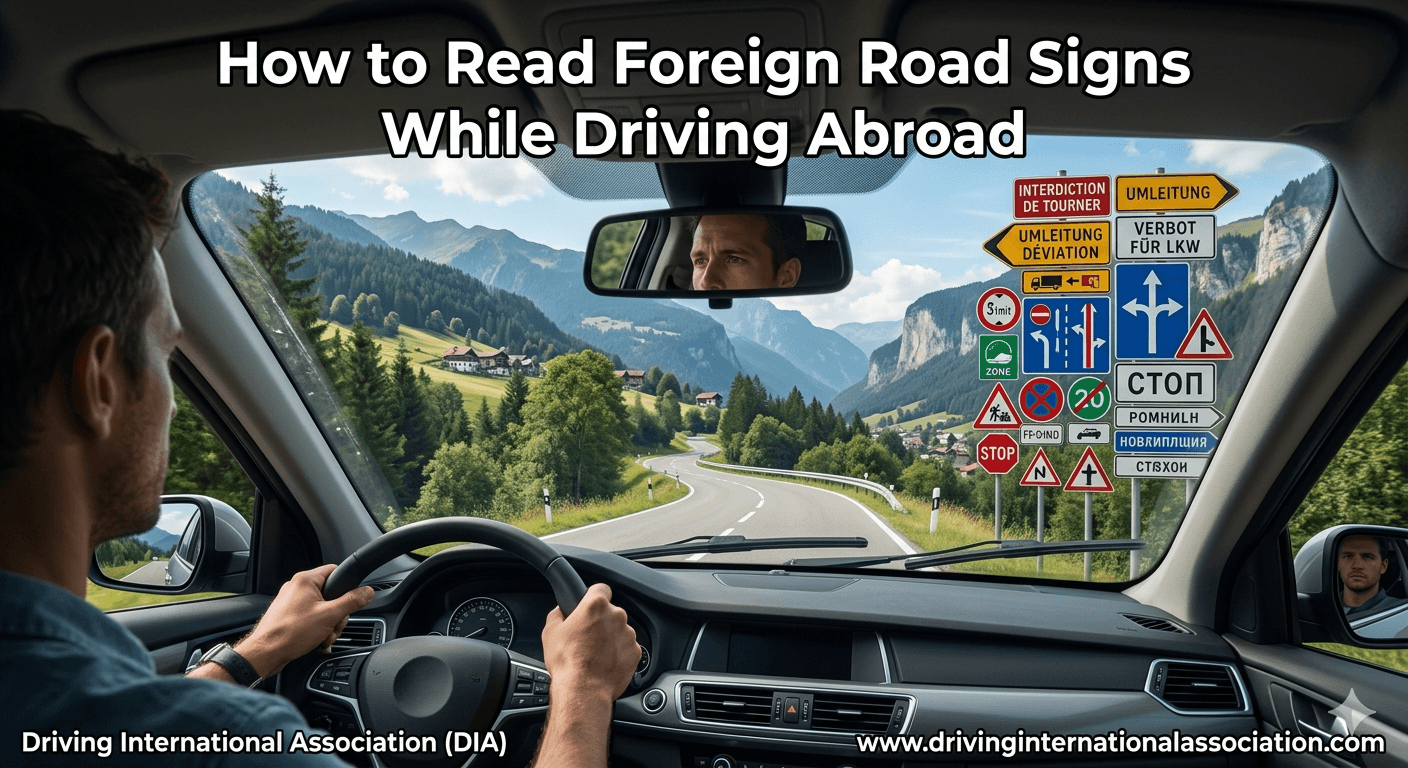
Driving in a country where you can't read the language can feel daunting — but road signs are more universal than you might think. Thanks to international conventions, you can understand most signs by their shape, colour, and symbols, even without knowing the words. This guide explains how to read foreign road signs confidently.
The Power of International Conventions
Much of the world follows broadly standardised sign conventions, largely stemming from international agreements on road signs and signals. This means shapes and colours carry consistent meanings across many countries, so even unfamiliar signs are often understandable. Learning these conventions equips you to read signs almost anywhere.
Understanding the underlying system lets you interpret signs regardless of the local language.
Expert Driving Tip: Before any trip, spend ten minutes reviewing your destination's specific sign variations online — most countries' transport authorities publish official sign guides, and a quick read prevents the brief hesitation at unfamiliar signs that can be more dangerous than not knowing the sign at all.
Shapes and What They Mean
Shape is the first clue. Triangular signs typically warn of hazards ahead; circular signs usually give mandatory instructions or prohibitions; rectangular signs generally provide information. An octagon almost universally means stop. Recognising these shapes tells you the type of message before you even read the detail.
Reading the shape first gives you the sign's purpose at a glance.
Colours and Their Significance
Colour adds meaning. Red commonly indicates prohibition or danger — a red circle forbids, a red border warns. Blue circles often give positive instructions (like a mandatory direction), while blue rectangles provide information. Green and white frequently denote directions and place names. These colour cues are remarkably consistent worldwide.
Combining shape and colour lets you grasp most signs' meaning instantly.
Common Symbols to Know
Many symbols are intuitive and international: a person walking for pedestrian crossings, a car for parking, an exclamation mark for general warnings, and pictograms for animals, falling rocks, or road narrowing. Speed limits appear as numbers in red circles. Familiarising yourself with common pictograms before travelling builds quick recognition.
A little advance study of common symbols makes foreign signs feel familiar fast.
Where Signs Differ
While conventions are broad, some countries have local variations, different scripts, or unique signs. The USA, for instance, uses more text-based signs and some different conventions than the international standard. Researching your specific destination's notable sign differences before you drive avoids confusion on the road.
Checking for local sign quirks completes your preparation for reading them confidently.
Using Technology to Help
Translation apps with camera functions can read and translate text-based signs in real time, invaluable for written information signs in unfamiliar scripts. Navigation apps also convey speed limits and directions. While you should learn the visual conventions, technology is a useful backup for the text-heavy signs that symbols can't cover.
Pairing your knowledge of conventions with translation tech covers virtually every sign you'll meet.
Building Sign-Reading Confidence
Before you travel, review your destination's road signs — many transport authorities publish guides. On the road, read shape and colour first, then the detail, and don't panic over unfamiliar signs; their type is usually clear from the visual cues. With a little preparation, foreign signs quickly become second nature.
Preparation and practice turn intimidating foreign signs into an easily readable system.
Signs, Documents, and Confident Driving
Reading signs is one part of confident driving abroad; having your documents in order is another. With your national licence and IDP sorted, and the ability to read the road, you're equipped to drive almost anywhere. Together, they remove the two biggest sources of anxiety for drivers in unfamiliar countries.
Combining sign-reading skills with proper documents makes driving in any country approachable.
Drive Prepared With DIA
Reading foreign road signs is one half of confident driving abroad; having the right documents is the other. Driving International Association (DIA) provides a genuine IDP that translates your national licence into a recognised format, delivered digitally in 2 hours. Paired with your ability to read the road, a DIA IDP — verifiable by QR code and built on the UN conventions — means you're equipped to drive almost anywhere, with both the signs and the paperwork fully under control.
Frequently Asked Questions
Q1: What is an International Driving Permit and do I need one?
An IDP is a multilingual translation of your driving licence recognised in 150+ countries. If you're driving abroad and your destination requires one, Driving International Association (DIA) delivers your IDP Digital Booklet in 2 hours from $21.
Q2: What is the difference between the IDP Digital Booklet and the NFC Smart Kit?
The IDP Digital Booklet is your official primary IDP delivered digitally in 2 hours, with a complimentary Digital Smart Card included. The NFC Smart Kit gives you the physical IDP Booklet with a complimentary physical Smart NFC Card — ideal for countries like Thailand and Japan that expect physical documentation.
Q3: How fast does Driving International Association deliver an IDP?
The IDP Digital Booklet (with complimentary Digital Smart Card) is delivered within 2 hours of payment. The physical NFC Smart Kit ships separately after digital delivery.
Q4: Is the Driving International Association IDP accepted internationally?
Driving International Association issues IDPs aligned with the 1949 Geneva and 1968 Vienna UN Conventions on Road Traffic — the international framework recognised by rental companies and transport authorities in 150+ countries.
Q5: How much does a Driving International Association IDP cost?
IDP Digital Booklet: $21 (1yr), $26 (2yr), $32 (3yr). NFC Smart Kit (physical IDP Booklet + complimentary Smart NFC Card): $32 (1yr), $37 (2yr), $42 (3yr). 100% money-back guarantee on all orders.
Q6: Does an IDP replace my driving licence?
No. The IDP Digital Booklet is a translation of your existing licence and must always be carried alongside it. Both documents are required when driving abroad.
Have questions? Chat with Driving International Association on WhatsApp — 24/7 →