Quick Summary
- The underlying IDP framework applies even in remote, less-documented destinations — it's the same translation principle everywhere.
- Many remote island nations rely more on boats than cars, meaning driving may be a minor part of your trip there.
- A digital IDP is especially valuable for remote travel, since it can be obtained online from anywhere without relying on local services.
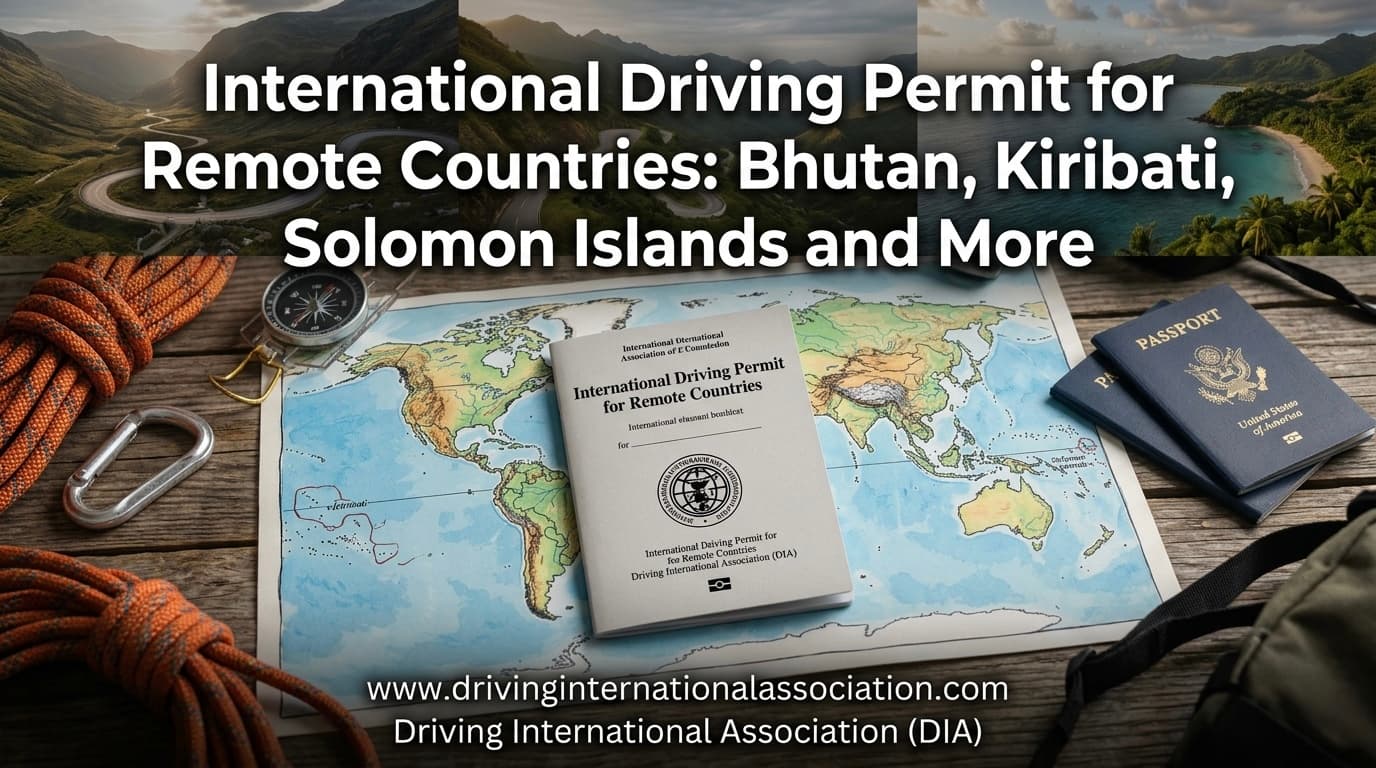
Most IDP guides focus on popular destinations, but travellers heading to remote and less-common countries — Bhutan, Kiribati, the Solomon Islands, and similar — also need to know how driving permits work there. This guide explains how International Driving Permits apply to these off-the-beaten-path destinations, and how to be road-legal wherever your adventure takes you.
Why Remote-Country IDP Info Is Hard to Find
For popular destinations, IDP rules are widely documented, but for remote nations like Bhutan, Kiribati, and the Solomon Islands, reliable information can be scarce. This leaves travellers uncertain about whether they need an IDP and how to get one. The good news is that the underlying principles are the same everywhere, even if the specifics are less publicised.
Understanding the general framework helps you approach even the most obscure destination with confidence.
Expert Driving Tip: For remote destinations with limited information available online, contact your destination's tourism board directly to confirm current driving and IDP requirements — official channels are often more reliable than outdated forum posts for genuinely obscure locations.
The Universal Role of the IDP
Wherever you go, an International Driving Permit serves the same purpose: it's the official translation of your national licence, based on the 1949 and 1968 UN Conventions, helping local authorities and rental providers read your credentials. Even in remote nations where the local language is unfamiliar, the IDP provides that standardised translation.
This universal function means an IDP is valuable in remote countries precisely because local familiarity with foreign licences may be low.
Driving in Bhutan
Bhutan, the Himalayan kingdom, has a distinctive tourism model, and many visitors travel with arranged transport and guides. For those who do drive, an IDP serves as the recognised translation of your national licence, with a Bhutanese licence via the Road Safety and Transport Authority relevant for residents. Bhutan drives on the left through dramatic mountain terrain, so caution is essential.
For the rare self-driving visitor to Bhutan, an IDP plus national licence is the sensible documentation.
Driving in Kiribati and Pacific Island Nations
Kiribati and similar Pacific island nations are remote, with limited road networks concentrated on main islands. Where driving is possible, an IDP provides the recognised translation of your licence. Transport in these scattered island nations often relies more on boats than cars, so driving may be a minor part of your trip.
In such destinations, an IDP covers the limited driving you may do, while much travel happens by sea.
Driving in the Solomon Islands
The Solomon Islands, another Pacific nation, has roads mainly on the larger islands, with rougher rural routes that may need a sturdy vehicle. The country drives on the left, and an IDP serves as your licence translation for any driving or rentals. As with other remote nations, road conditions and infrastructure vary considerably.
An IDP ensures you're documented for driving in the Solomon Islands, where foreign-licence familiarity may be limited.
Why Digital IDPs Suit Remote Travel
For remote destinations, a digital IDP is especially valuable. You can obtain one online in 2 hours from anywhere — including just before you travel — without relying on local document services that may not exist in remote nations. Keep an offline copy, since connectivity can be patchy in such places.
The ability to get a digital IDP from anywhere makes it ideal preparation for off-the-beaten-path journeys.
Practical Tips for Remote-Country Driving
For any remote destination: get your IDP before you travel, since local services may be unavailable; research road conditions and the driving side; prepare for limited infrastructure, fuel, and connectivity; and consider whether arranged transport might suit better than self-driving. An IDP, an offline copy, and good preparation cover the essentials.
Thorough preparation is even more important in remote countries, where help and services may be far away.
Being Road-Legal Anywhere
In summary: whether you're heading to Bhutan, Kiribati, the Solomon Islands, or any remote nation, an IDP provides the universal translation of your national licence that helps you drive legally. Get a digital IDP before you travel, keep an offline copy, and prepare for the specific conditions of your destination. With these, you're road-ready even in the world's most remote corners.
An IDP and good preparation let you drive confidently wherever your sense of adventure leads.
Other Less-Common IDP Destinations
Beyond Bhutan, Kiribati, and the Solomon Islands, travellers head to many other less-documented nations — small Pacific and Caribbean states, remote parts of Africa and Central Asia, and more. The same principles apply: an IDP provides the universal translation of your licence, get it before you travel, and research local road conditions and the driving side.
Whatever obscure destination you're bound for, the IDP framework gives you a reliable starting point for being road-legal.
Preparing for Limited Infrastructure
Remote nations often have limited fuel stations, patchy connectivity, basic road networks, and few services if something goes wrong. Prepare accordingly: carry an offline copy of your IDP, plan fuel and supplies, tell someone your route, and consider whether a sturdy or 4x4 vehicle suits the terrain. Self-sufficiency matters where help is far away.
Combining the right documents with thorough practical preparation is the key to safe driving in remote countries.
Frequently Asked Questions
Q1: What is an International Driving Permit and do I need one?
An IDP is a multilingual translation of your driving licence recognised in 150+ countries. If you're driving abroad and your destination requires one, Driving International Association (DIA) delivers your IDP Digital Booklet in 2 hours from $21.
Q2: What is the difference between the IDP Digital Booklet and the NFC Smart Kit?
The IDP Digital Booklet is your official primary IDP delivered digitally in 2 hours, with a complimentary Digital Smart Card included. The NFC Smart Kit gives you the physical IDP Booklet with a complimentary physical Smart NFC Card — ideal for countries like Thailand and Japan that expect physical documentation.
Q3: How fast does Driving International Association deliver an IDP?
The IDP Digital Booklet (with complimentary Digital Smart Card) is delivered within 2 hours of payment. The physical NFC Smart Kit ships separately after digital delivery.
Q4: Is the Driving International Association IDP accepted internationally?
Driving International Association issues IDPs aligned with the 1949 Geneva and 1968 Vienna UN Conventions on Road Traffic — the international framework recognised by rental companies and transport authorities in 150+ countries.
Q5: How much does a Driving International Association IDP cost?
IDP Digital Booklet: $21 (1yr), $26 (2yr), $32 (3yr). NFC Smart Kit (physical IDP Booklet + complimentary Smart NFC Card): $32 (1yr), $37 (2yr), $42 (3yr). 100% money-back guarantee on all orders.
Q6: Does an IDP replace my driving licence?
No. The IDP Digital Booklet is a translation of your existing licence and must always be carried alongside it. Both documents are required when driving abroad.
Have questions? Chat with Driving International Association on WhatsApp — 24/7 →