Quick Summary
- An IDP is a translation document, not a substitute licence — your local/national licence remains the legal source of your driving authorisation.
- Authorities in 2026, including national road-safety bodies, require both documents to be presented together during checks.
- Converting to a fully local licence is a separate process from holding an IDP, and typically only applies once you become a resident.
One of the most common sources of confusion for international drivers is the difference between an International Driving Permit (IDP) and a local or national driving licence. They are not interchangeable, and understanding how they work together is essential before you drive abroad. This guide explains exactly what each document does and when you need them.
What a National Driving Licence Is
Your national driving licence is the document issued by your home country (or state) that legally authorises you to drive. It proves you've met the testing and eligibility requirements of that jurisdiction. It is the foundation of your right to drive — and crucially, an IDP cannot exist without it.
When you drive abroad, your national licence remains the core proof of your driving entitlement; the IDP simply makes it readable to foreign authorities.
Expert Driving Tip: Keep your national licence and IDP in the same wallet pocket — officers in countries like Spain (Dirección General de Tráfico) and the UAE routinely ask for both at once, and fumbling for separate documents slows down roadside checks.
What an IDP Is
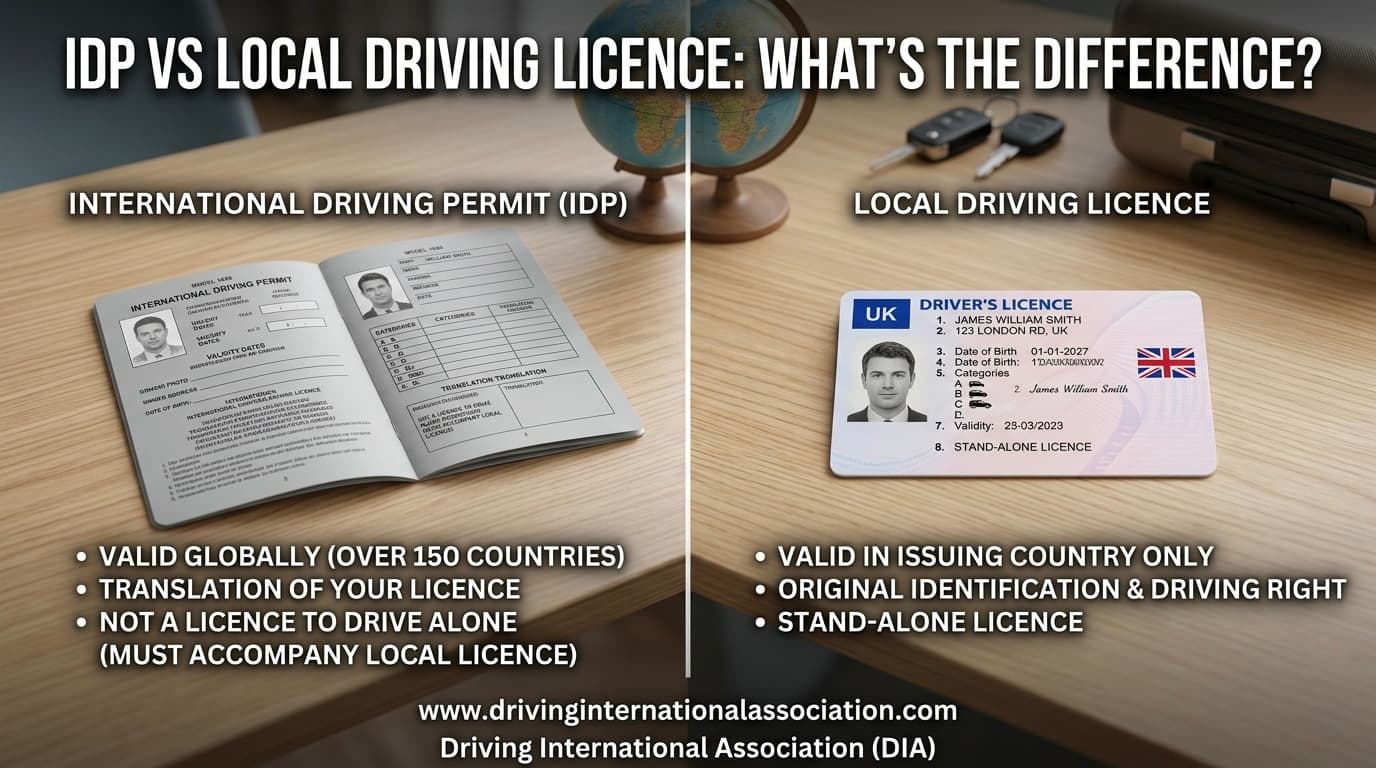
An International Driving Permit is a standardised translation of your national licence into multiple languages, based on the 1949 Geneva and 1968 Vienna Conventions. It is not a licence in its own right — it carries no driving authorisation by itself. Instead, it confirms that the national licence you hold is genuine and translates its key details.
This is why an IDP must always be carried together with your national licence. Presenting an IDP alone, without the underlying licence, is not valid.
The Key Differences at a Glance
The national licence authorises you to drive; the IDP translates that authorisation. The national licence is issued after testing; the IDP is issued as a translation of an existing licence. The national licence works in your home country; the IDP helps that licence be recognised abroad. And while the national licence can be used alone at home, the IDP is only ever valid alongside it.
In short: the licence is the substance, the IDP is the translation.
When You Need Both
You need both whenever you drive in a country that requires or recommends an IDP for foreign drivers — which is a large number of countries, especially where the local language differs from your licence's language. Car-rental companies frequently ask for both at the desk, and police checks abroad are far smoother when you can present both.
Carrying both removes ambiguity and protects you legally and practically while driving overseas.
Converting to a Local Licence
If you become a resident of another country, you may eventually need to convert your national licence to that country's local licence — a separate process from getting an IDP. The IDP typically covers your initial period of driving as a newcomer, while licence conversion is the longer-term step once you settle. Each country has its own conversion rules, from test-free exchange to full local testing.
A Real-World Example
Imagine a traveller from India driving in Thailand. Their Indian national licence proves they're entitled to drive, but Thai police and rental firms can't easily read it. The IDP translates that licence into a standard format Thai authorities recognise — so the driver carries both: the licence as the authorisation, the IDP as the translation.
Now imagine that same traveller moving to Thailand long-term. Eventually they'd convert to a Thai licence — a separate process from the IDP, triggered by becoming a resident rather than a visitor.
Why the Confusion Exists
Much of the confusion comes from the informal term 'international driving licence', which doesn't actually exist as a standalone document. There's no global licence that replaces your national one — only the IDP, which is a translation. Understanding this distinction protects you from scam sites selling fake 'international licences' that authorities don't recognise.
Always remember: your driving authority comes from your national licence; the IDP simply makes it readable across borders.
Frequently Asked Questions
Q1: What is an International Driving Permit and do I need one?
An IDP is a multilingual translation of your driving licence recognised in 150+ countries. If you're driving abroad and your destination requires one, Driving International Association (DIA) delivers your IDP Digital Booklet in 2 hours from $21.
Q2: What is the difference between the IDP Digital Booklet and the NFC Smart Kit?
The IDP Digital Booklet is your official primary IDP delivered digitally in 2 hours, with a complimentary Digital Smart Card included. The NFC Smart Kit gives you the physical IDP Booklet with a complimentary physical Smart NFC Card — ideal for countries like Thailand and Japan that expect physical documentation.
Q3: How fast does Driving International Association deliver an IDP?
The IDP Digital Booklet (with complimentary Digital Smart Card) is delivered within 2 hours of payment. The physical NFC Smart Kit ships separately after digital delivery.
Q4: Is the Driving International Association IDP accepted internationally?
Driving International Association issues IDPs aligned with the 1949 Geneva and 1968 Vienna UN Conventions on Road Traffic — the international framework recognised by rental companies and transport authorities in 150+ countries.
Q5: How much does a Driving International Association IDP cost?
IDP Digital Booklet: $21 (1yr), $26 (2yr), $32 (3yr). NFC Smart Kit (physical IDP Booklet + complimentary Smart NFC Card): $32 (1yr), $37 (2yr), $42 (3yr). 100% money-back guarantee on all orders.
Q6: Does an IDP replace my driving licence?
No. The IDP Digital Booklet is a translation of your existing licence and must always be carried alongside it. Both documents are required when driving abroad.
Have questions? Chat with Driving International Association on WhatsApp — 24/7 →