Quick Summary
- Asia mixes left-side (Japan, Thailand, India) and right-side (Vietnam, China, South Korea) driving countries, so always confirm before you travel.
- Japan recognises only the 1949 Geneva IDP; Vietnam recognises only the 1968 Vienna type — China recognises neither and requires a local licence.
- Megacity traffic in places like Bangkok and Jakarta is often dense enough that hiring a driver is more practical than self-driving.
Asia offers some of the world's most diverse driving experiences — from Japan's orderly roads to the bustling chaos of Southeast Asian cities and the vast landscapes of Central Asia. But the rules vary enormously across the continent. This guide covers what every traveller should know about driving in Asia, including IDPs, driving sides, and local realities.
IDP Conventions Differ Across Asia
Asia is where IDP convention type matters most. Japan recognises only the 1949 Geneva Convention IDP. Vietnam recognises the 1968 Vienna Convention IDP. China recognises neither and requires a Chinese licence to drive. Most other Asian countries recognise IDPs more broadly, but these exceptions make checking essential.
Confirming the exact IDP type your destination accepts is the single most important step for driving in Asia.
Expert Driving Tip: In dense Asian megacities, watch how local drivers merge rather than relying solely on mirrors and indicators — much of the traffic flow operates on assertive, continuous negotiation between vehicles that differs sharply from indicator-led merging in Europe or North America.
Left vs Right Across the Continent
Asia is split on driving sides. Japan, Thailand, Indonesia, Malaysia, India, Pakistan, Nepal, Sri Lanka, Bangladesh, and Brunei drive on the left. China, South Korea, Vietnam, the Philippines, Cambodia, Laos, the Central Asian states, and the Middle East drive on the right. For multi-country Asian trips, be ready to switch sides.
Knowing the driving side of each country you'll visit helps you prepare mentally for the road ahead.
Megacity Traffic Realities
Many Asian cities — Bangkok, Jakarta, Manila, Delhi, Dhaka, Ho Chi Minh City — have intense, dense traffic that can overwhelm visiting drivers. In these places, ride-hailing or hired drivers are often more practical than self-driving. Where you do drive, patience and defensive driving are essential amid heavy motorbike and scooter traffic.
Being realistic about megacity traffic helps you decide when to drive and when to let someone else.
The Scooter Culture of Southeast Asia
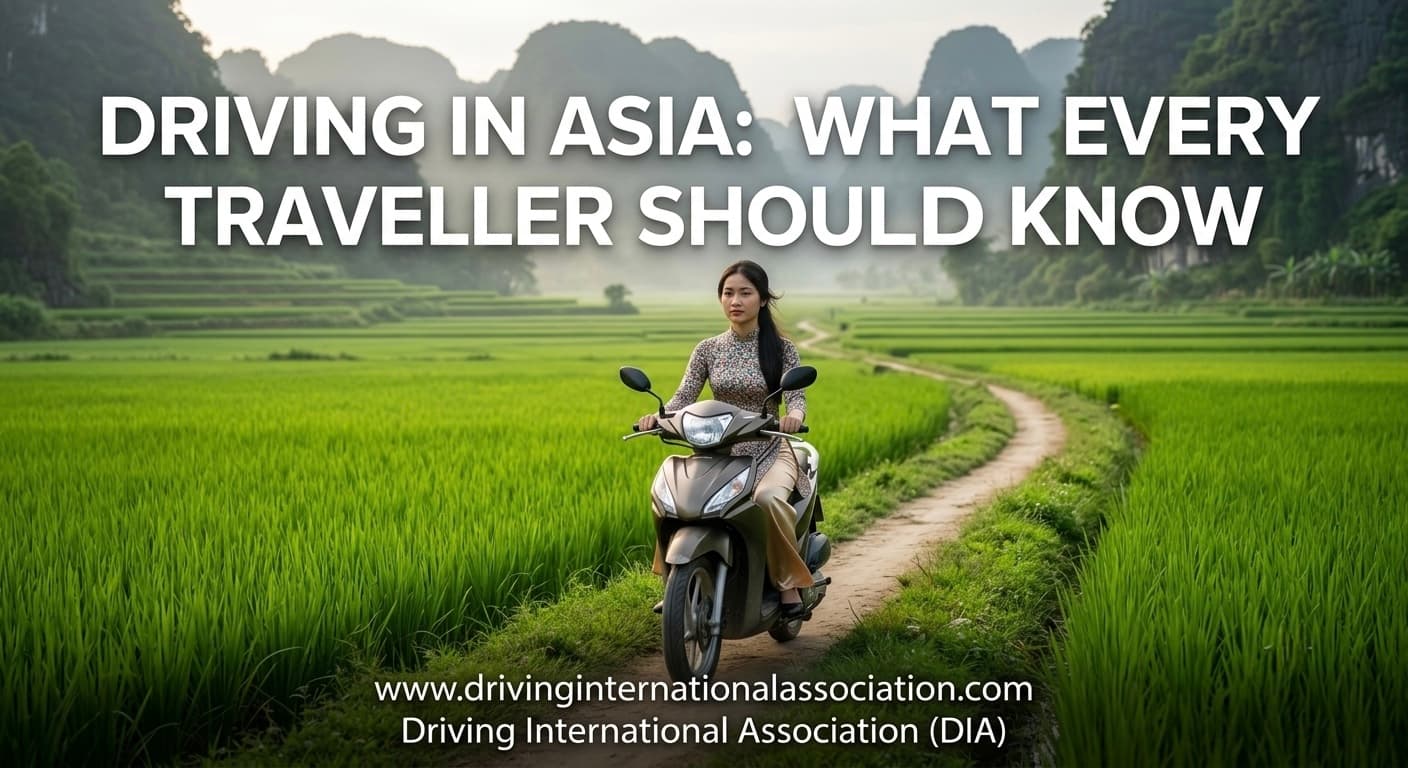
In Bali, Thailand, Vietnam, and beyond, scooters dominate. Renting one is easy and popular, but requires an IDP showing the motorcycle category — and your home licence must include that entitlement. Indonesia and others require the IDP for foreign drivers, and police checks are common. Helmets and care are essential given high accident rates.
Two-wheeled travel is a joy in Southeast Asia, but only with the right documents and caution.
Licence Conversion for Longer Stays
If you're staying long-term in an Asian country for work or study, you'll likely need to convert to a local licence. Japan's gaimen kirikae, Korea's reciprocity-based conversion, and various Southeast Asian processes all differ. The IDP covers your initial driving, while conversion becomes relevant as you settle into residency.
Understanding the conversion path for your specific country helps long-stay travellers plan ahead.
Navigation and Local Apps
Global apps don't always work well in Asia. South Korea limits Google Maps' driving functionality, so locals use Naver Map or KakaoMap. China uses its own apps in Chinese. Elsewhere, offline maps help in areas with patchy signal. Setting up the right navigation before you drive saves real frustration.
Matching your navigation tools to the country keeps you confidently on route.
Road Conditions and Safety
Road quality varies hugely across Asia — from Japan's immaculate highways to rough rural roads in mountainous or developing regions, some needing a 4x4. Wildlife, livestock, and pedestrians share many roads. Drive defensively, avoid night driving on poor rural routes, and adjust expectations to each country's infrastructure.
Respecting the local road reality is key to safe driving across this vast and varied continent.
Planning Your Asian Driving Trip
Before you go, confirm the IDP type and driving side for each country, research city-traffic realities, set up local navigation, and check whether scooter or 4x4 travel suits your plans. With these prepared, Asia rewards drivers with extraordinary variety — temples, mountains, coastlines, and cultures, all accessible by road.
Good preparation unlocks the immense diversity that makes driving in Asia so memorable.
Frequently Asked Questions
Q1: What is an International Driving Permit and do I need one?
An IDP is a multilingual translation of your driving licence recognised in 150+ countries. If you're driving abroad and your destination requires one, Driving International Association (DIA) delivers your IDP Digital Booklet in 2 hours from $21.
Q2: What is the difference between the IDP Digital Booklet and the NFC Smart Kit?
The IDP Digital Booklet is your official primary IDP delivered digitally in 2 hours, with a complimentary Digital Smart Card included. The NFC Smart Kit gives you the physical IDP Booklet with a complimentary physical Smart NFC Card — ideal for countries like Thailand and Japan that expect physical documentation.
Q3: How fast does Driving International Association deliver an IDP?
The IDP Digital Booklet (with complimentary Digital Smart Card) is delivered within 2 hours of payment. The physical NFC Smart Kit ships separately after digital delivery.
Q4: Is the Driving International Association IDP accepted internationally?
Driving International Association issues IDPs aligned with the 1949 Geneva and 1968 Vienna UN Conventions on Road Traffic — the international framework recognised by rental companies and transport authorities in 150+ countries.
Q5: How much does a Driving International Association IDP cost?
IDP Digital Booklet: $21 (1yr), $26 (2yr), $32 (3yr). NFC Smart Kit (physical IDP Booklet + complimentary Smart NFC Card): $32 (1yr), $37 (2yr), $42 (3yr). 100% money-back guarantee on all orders.
Q6: Does an IDP replace my driving licence?
No. The IDP Digital Booklet is a translation of your existing licence and must always be carried alongside it. Both documents are required when driving abroad.
Have questions? Chat with Driving International Association on WhatsApp — 24/7 →