Quick Summary
- Tourists driving in the UAE and other Gulf states typically need an IDP alongside their national licence at rental counters.
- Automated speed-camera enforcement across the Gulf, particularly in the UAE and Saudi Arabia, is strict and fines arrive quickly.
- All Middle Eastern countries drive on the right, with modern, wide highways and generally inexpensive fuel.
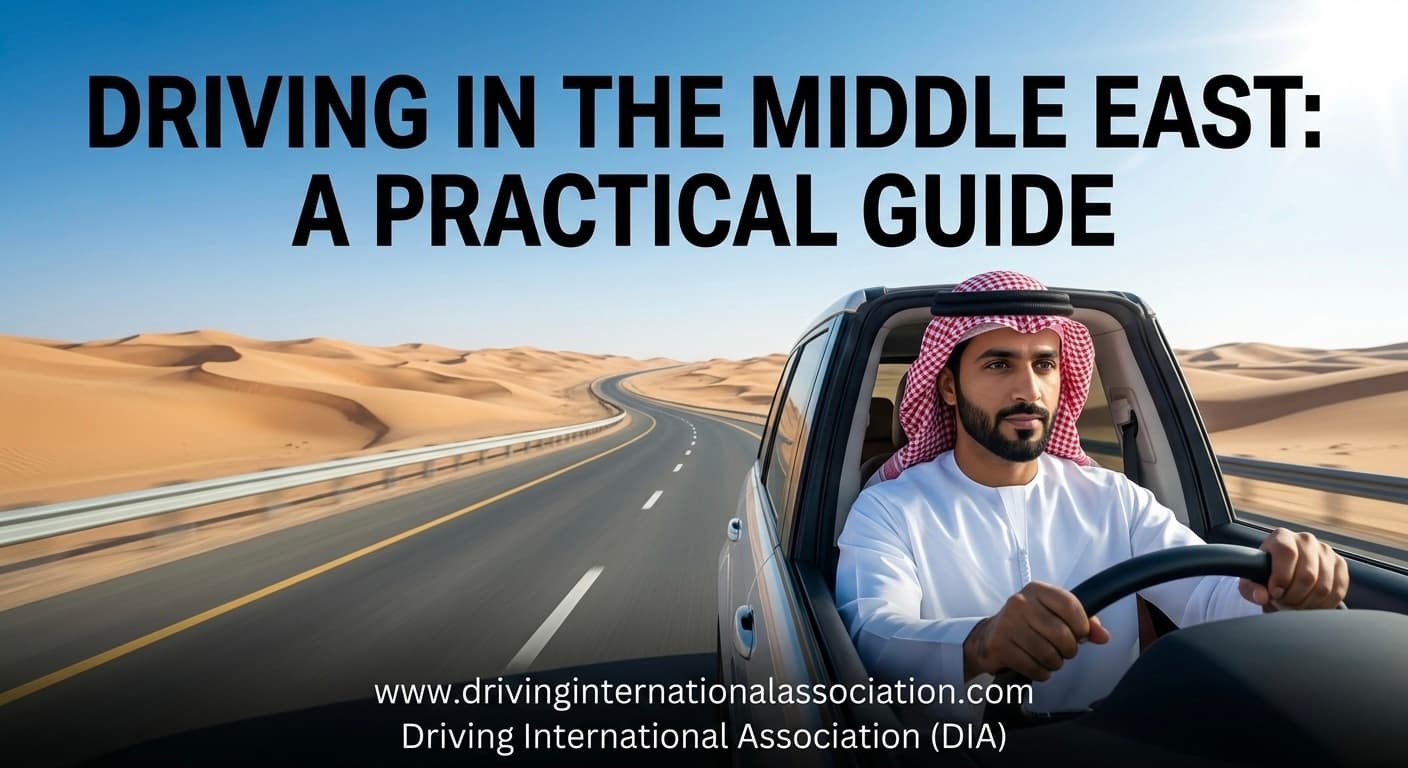
The Middle East is highly car-dependent, with modern highways, inexpensive fuel, and a culture built around driving. For visitors and expats alike, getting on the road is straightforward with the right preparation. This practical guide covers IDPs, licence transfer, enforcement, and the road realities of driving across the Middle East.
IDPs for Visitors
Tourists and short-term visitors to the Middle East should carry an International Driving Permit alongside their national licence. In the UAE and elsewhere, rental companies expect an IDP from most nationalities, and it serves as the recognised translation for police checks. Getting one before you travel ensures you can rent and drive without dispute.
For any visitor planning to drive in the region, the IDP is a simple, essential piece of preparation.
Expert Driving Tip: Set up your Salik or Darb toll account before you start driving in Dubai or Abu Dhabi — unregistered rental cars passing through toll gates without an active account can accumulate administrative fees on top of the toll itself by the time you return the vehicle.
Gulf Licence Transfer for Residents
Expats who become residents in the Gulf typically transfer their national licence to a local one. Many nationalities qualify for a test-free transfer — subject to an eye test and paperwork — in the UAE, Saudi Arabia, Qatar, Bahrain, and Oman. Kuwait is stricter, with salary and residency conditions. The IDP covers your initial driving before the transfer completes.
Understanding your eligibility for test-free transfer is key for expats settling in the region.
Strict Automated Enforcement
The Middle East is known for strict, automated traffic enforcement. Saudi Arabia's Saher system and the UAE's extensive speed cameras catch violations and issue fines quickly. Speed limits are enforced precisely, and penalties can be significant. The simple rule is to stay within limits — automated systems leave little room for leniency.
Respecting the cameras and limits keeps your driving record and wallet intact across the Gulf.
Tolls and Road Systems
Toll systems are electronic and seamless: Dubai's Salik, Abu Dhabi's Darb, and similar systems elsewhere automatically charge for using certain roads. Set up the relevant account or ensure your rental is registered. Roads are generally excellent, wide, and fast, with clear signage in Arabic and English across most of the region.
Sorting your toll arrangement avoids fines and keeps your journeys smooth.
Driving Culture and Conditions
All Middle Eastern countries drive on the right. Driving can be fast and assertive, particularly on multi-lane highways, so defensive driving is wise. Summer heat is extreme, making vehicle air-conditioning and hydration important. Fuel is inexpensive, making road trips affordable, and the region offers dramatic desert and mountain scenery to explore.
Adapting to the local pace and conditions makes driving in the Middle East both safe and enjoyable.
Beyond the Gulf
The wider Middle East — Jordan, Lebanon, Turkey, and others — has its own rules. Jordan and Lebanon recognise IDPs for visitors, with local licences for residents; Turkey allows six months on a foreign licence before conversion. Jordan's Petra and Wadi Rum, and Turkey's vast landscapes, reward road trips for the prepared driver.
Checking each country's specific rules opens up the rich driving opportunities beyond the Gulf states.
Safety and Practical Tips
Carry your IDP and national licence together, set up tolls, and respect speed cameras. Plan around the midday heat in summer, keep water in the car, and fuel up before long desert stretches. Know the local emergency number, and ensure your insurance is in order. With these basics covered, Middle Eastern driving is comfortable and efficient.
A little preparation lets you enjoy the region's excellent roads and striking scenery with confidence.
Getting Road-Ready for the Region
In summary: get your IDP before arriving; understand whether you're driving as a visitor or transferring as a resident; set up tolls; respect strict enforcement; and prepare for heat and distances. The Middle East rewards drivers with modern infrastructure and remarkable landscapes once these essentials are in place.
With the right preparation, the region is one of the easiest and most rewarding places to drive.
Frequently Asked Questions
Q1: What is an International Driving Permit and do I need one?
An IDP is a multilingual translation of your driving licence recognised in 150+ countries. If you're driving abroad and your destination requires one, Driving International Association (DIA) delivers your IDP Digital Booklet in 2 hours from $21.
Q2: What is the difference between the IDP Digital Booklet and the NFC Smart Kit?
The IDP Digital Booklet is your official primary IDP delivered digitally in 2 hours, with a complimentary Digital Smart Card included. The NFC Smart Kit gives you the physical IDP Booklet with a complimentary physical Smart NFC Card — ideal for countries like Thailand and Japan that expect physical documentation.
Q3: How fast does Driving International Association deliver an IDP?
The IDP Digital Booklet (with complimentary Digital Smart Card) is delivered within 2 hours of payment. The physical NFC Smart Kit ships separately after digital delivery.
Q4: Is the Driving International Association IDP accepted internationally?
Driving International Association issues IDPs aligned with the 1949 Geneva and 1968 Vienna UN Conventions on Road Traffic — the international framework recognised by rental companies and transport authorities in 150+ countries.
Q5: How much does a Driving International Association IDP cost?
IDP Digital Booklet: $21 (1yr), $26 (2yr), $32 (3yr). NFC Smart Kit (physical IDP Booklet + complimentary Smart NFC Card): $32 (1yr), $37 (2yr), $42 (3yr). 100% money-back guarantee on all orders.
Q6: Does an IDP replace my driving licence?
No. The IDP Digital Booklet is a translation of your existing licence and must always be carried alongside it. Both documents are required when driving abroad.
Have questions? Chat with Driving International Association on WhatsApp — 24/7 →